
Best binoculars for a safari holiday

Although you’ll get closer to wildlife than you can ever imagine on a safari holiday, a good pair of binoculars are still key to your enjoyment and everyone needs a pair. To help you choose the best binoculars, we’ll start with the following questions:
1. Is there a best binocular brand?
2. What binocular magnification is best for safari?
3. What do the numbers on binoculars mean?
Binoculars for a safari holiday – best brand?
While there’s no ‘best’ make for everyone, as budget will sometimes rule certain brands out, you’ll typically find the same names coming up time and again: Swarovski, Bushnell, Nikon, Leica, and Zeiss. These manufacturers are often involved with other optical equipment, such as cameras, since lens quality is of prime importance in both.

Cheetah spotted at Phinda Game Reserve, South Africa
Best binocular magnification for safari
Most people on safari will stick to a magnification of 7 or 8 which gives you a wide field of view and reacts less to any shake. Higher magnifications are possible and keen birdwatchers might choose a magnification of 10 or 12.
What does the other number mean?
The other number when binoculars are specified 8x?? is the size of the front lens. The bigger this number the more light will be gathered, particularly important on a safari holiday in the low light of an early morning wildlife drive, or as dusk falls at the other end of the day. Bigger lenses do mean heavier, bulkier binoculars though, so there’s a trade-off between portability and what you can see.

Rather than buying your binoculars over the internet, go into a shop – camera shops, such as Jessops, and outdoors shops, including Cotswold or Go Outdoors, often carry a binocular range – and try out some different options. Take the rucksack and jacket you’re taking on safari and see if the binoculars fit into a pocket, and check how comfortable they are to hold to your face for a few minutes as if you’re watching wildlife. Make sure they fit with your eyes so they are lined up with your pupils.
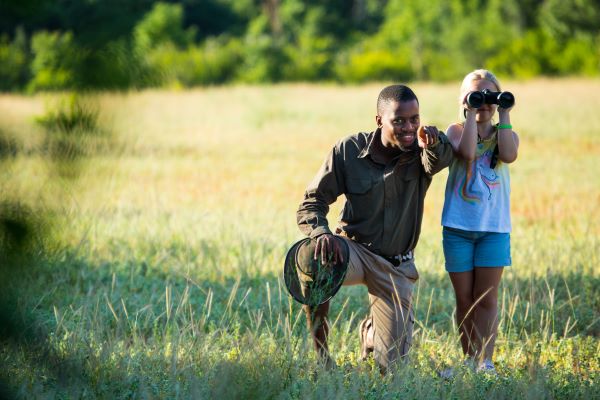
Walking safari in Botswana
So what binoculars do safari guides use?
As they’re a tool of daily life in the bush – and you’ll rarely find a guide without a pair around their neck – we spoke to some of Africa’s top safari guides about the binoculars they use, the advice they’d give to guests, and the stories behind how they came to rely on them in the field.
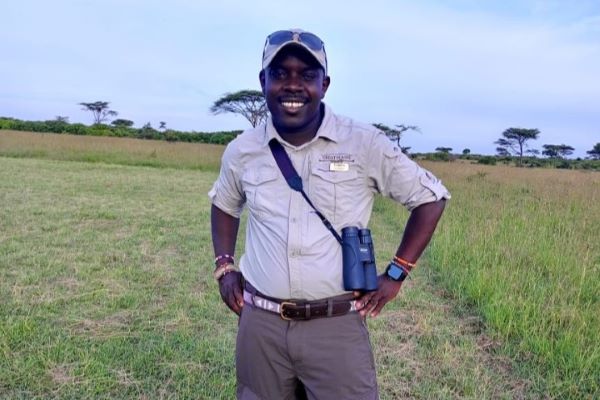
Dickson standing with his prized bino’s
Dickson Nabaala – Mara Nyika, Kenya
I was born and raised on the breathtaking plains of the Masai Mara, in a village where nature was my closest companion. I’m one of 26 siblings, and I grew up herding livestock and regularly seeing the wild animals of which I shared my home—that’s where my passion for conservation started. After secondary school, I went to a wildlife college for a year, and I’ve now been guiding with Great Plains Conservation for five years.
I use Nikon Prostaff 8×42 binoculars, a good quality brand that have clear glass and durability – two things I always look for. If you’re choosing binoculars for safari, think about weight and magnification. You want something comfortable to carry and powerful enough to show the detail.
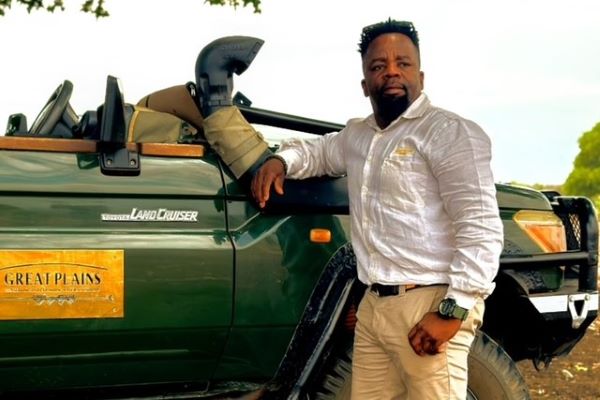
Matt Munuwa
Matt Munuwa – Tembo Plains, Zimbabwe
To cut a long story short- my name is Mathew Munuwa, also known as Matt. I was born and raised in a remote place in Northern Zimbabwe called Guruve and completed all of my education there. I knew the bush and a lot about nature long before joining the safari industry.
My career started in 2018 at Mpala Jena in Victoria Falls, working as a housekeeper. One day, a Pro Guide called Elliot Nobula asked if I’d be interested in studying guiding. I didn’t even think twice – I told him I was ready to start anytime. I joined a guiding class in Victoria Falls, and it came naturally to me. I grew up with my grandmother who taught me about plants, their medicinal uses, and told me stories about animals – both wild and domestic. After a few months of studying, I passed all my exams. I’m now working towards my full professional guiding licence. My guiding is based on passion—nothing else.
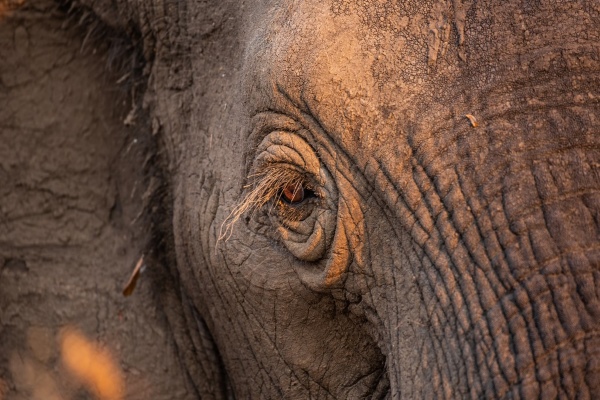
Binoculars enhance your view, revealing fine details like the folds around an elephant’s eye
I use the Leica Trinovid 8×42 HD, which offers me exceptional clarity, sharpness, and color accuracy, I get to see every detail of every wild animal and bird, the fine lines on an elephant’s trunk to the small markings on a leopard’s coat. Leica’s binoculars really shine in the variable lighting of Sapi Concession’s mornings and golden sunsets. And to add another reason, Africa can be dusty, humid, and full of sudden weather shifts. The Trinovid is water resistant, fog-proof, and has a robust, rubber-armoured body that gives a solid grip and can handle a few bumps in the Land Cruiser. Leica binoculars are built for the wild. When picking binoculars, I go for magnification, field of view, optical quality, and durability. For guests, I always say: know what you want them for, understand magnification and size, and test them out if you can before you buy.
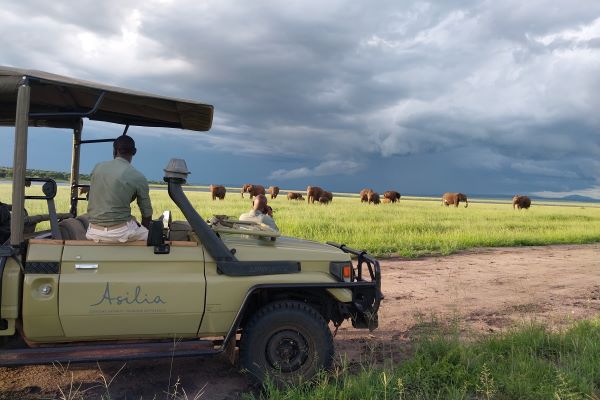
Charles Matara watches elephant on the grassy plains of Tanzania
Charles Matara – Asilia Africa, Tanzania
My name is Charles Matara, and I have been part of the Asilia family since 2016. I still remember the rigorous interview and training process I went through to earn my place- it was a challenge, but one that shaped me into the guide I am today. Beyond guiding, I am passionate about nurturing the next generation of Tanzanian guides and have been privileged to contribute to Asilia’s guide training team, helping others develop the same skills and appreciation for the wild that I have.
When it comes to gear, I’ve relied on Nikon binoculars for the past seven years—specifically, the Nikon Sport 8×42. They are lightweight, compact, and offer excellent clarity at an affordable price. Choosing the right binoculars depends on individual needs. For birdwatchers, high clarity is key, so I recommend 8-10×42 magnification from brands like Swarovski, Zeiss, or Leica. For guests who prefer walking safaris, weight and size are crucial considerations. There are many excellent brands available today, but for those looking for quality and affordability, Nikon, Bushnell, Vortex, and Celestron are excellent choices. Whatever you choose, 8-10×42 magnification is essential for the best experience in the bush.
Kevin Parmalai Sayialel - Mara Plains, Kenya
I grew up surrounded by wildlife, and that’s what inspired me to study tourism and become a guide. I’ve now been guiding for 15 years, all of them at Mara Plains, where I’m proud to be Head Guide. I love interacting with guests and interpreting signs, sounds, animal’s behaviours, and tracking. With influence from Dereck and Beverly Joubert, I’ve also developed my photography skills.
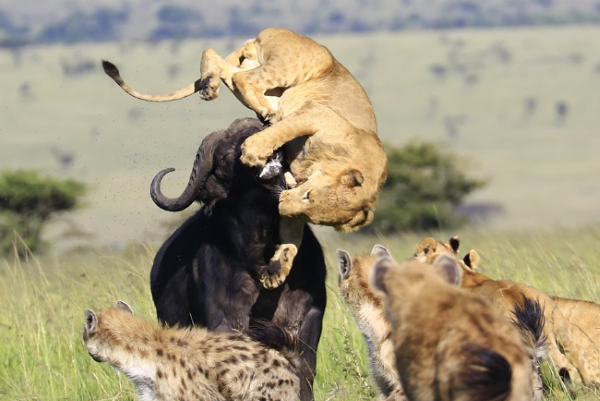
Kevin’s remarkable photograph of buffalo and lion in action.
Out in the field, I use Leica 10×42 binoculars. They offer great clarity and are well priced for the quality. When choosing binoculars, I always look for magnification and clear glass. For guests, my advice is simple: choose something that’s the right size and weight for you. You’ll be using them a lot, so they need to feel comfortable and steady in your hand.
Saba Douglas-Hamilton and Frank Pope – Elephant Watch Camp and Save The Elephants
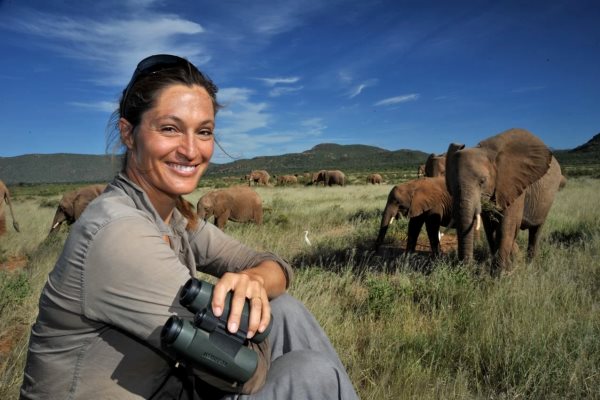
Saba Douglas-Hamilton
Saba’s parents Oria and Iain are renowned within Kenya as safari camp owners and conservationists, but Saba and husband Frank came to the forefront when their family’s move to Elephant Watch Camp in Samburu National Park was featured on the BBC series This Wild Life.
Saba has two binocular recommendations as the best for those coming on safari “10×42 for general animal viewing or 10×50 for keen birders” although she warns that the latter are pretty heavy.
Questions on binoculars or suggestions for this article?
Have we missed out your favourite binoculars or guide, or left you with an unanswered question? Please let us know in the comments section below, or pop us an email. We’ll be sure to reply and may amend the article to include our answer.
What next?
Get inspired and sign up for our free Insiders Guide to Africa. We would be delighted to help with planning your perfect safari. Our team of experts has travelled widely throughout Africa and the Indian Ocean and can offer expert advice. Do get in touch – chatting to people by phone or email is what we do best. We listen, we explain, we answer all sorts of questions, even those you didn’t know to ask, and finally we make suggestions. If this is your first time to Africa or your twenty first, we have a team standing by to help make the planning easy and the journey the best ever. Please get in touch, whatever stage you’re at.

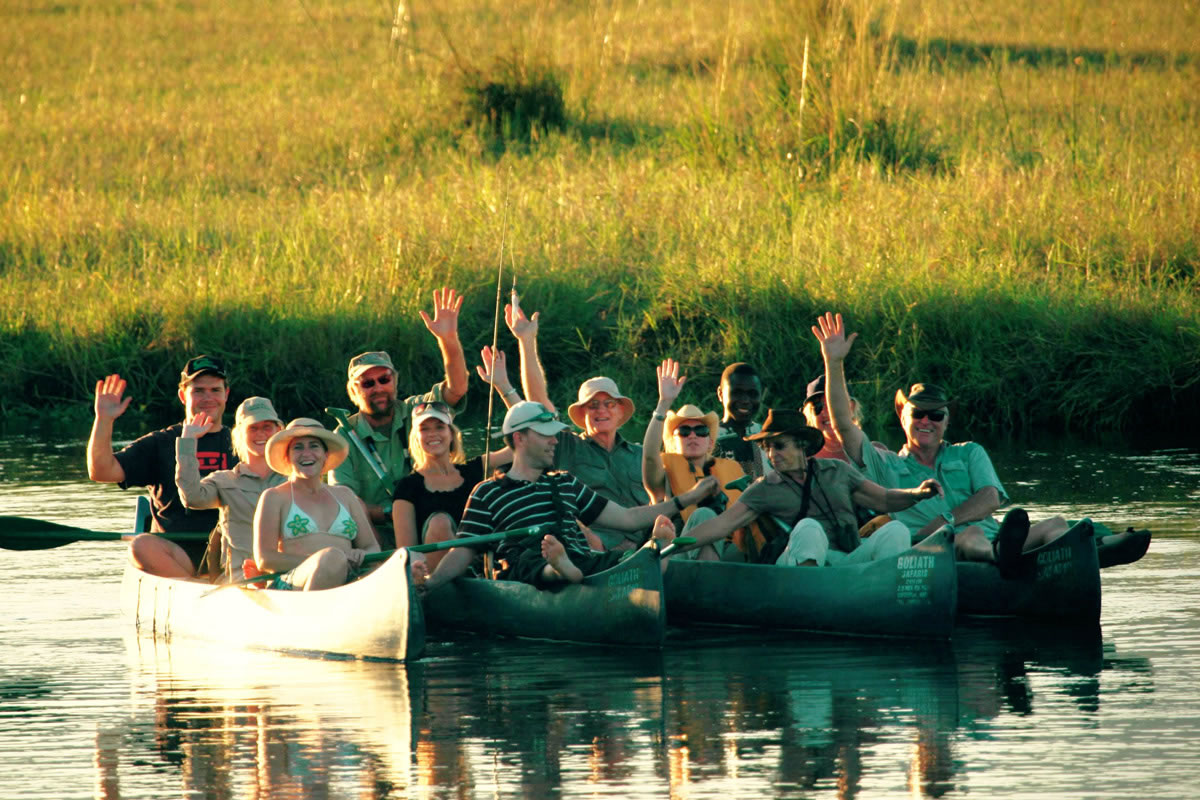 Goliath Safaris[/caption]
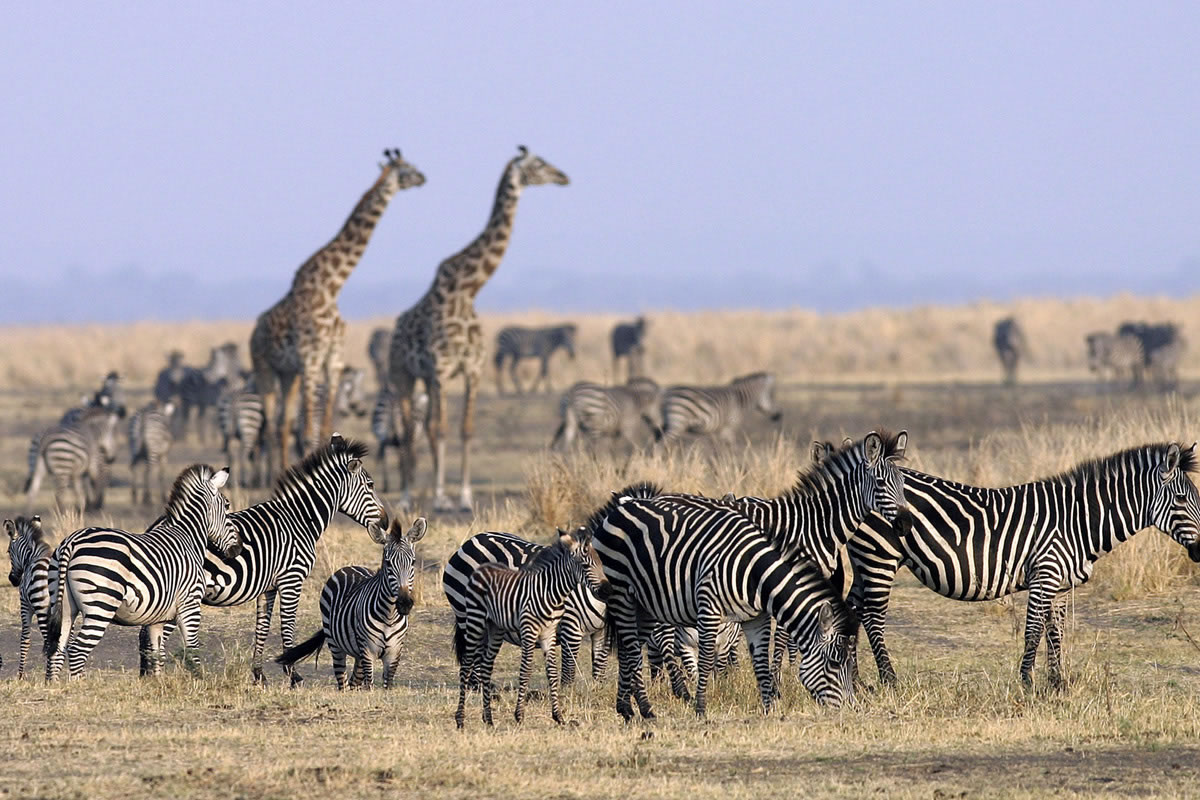 Chad Katavi[/caption]
 Jack's Camp[/caption]
Hi there,
Interesting article but I have a question. I only have vision in one eye so binoculars don’t really work for me. If I want to get a telescope instead, should I still look for an 8×42 or similar?
Any other recommendations are always welcome.
Thanks
Dear Pieter, thank you for your question. I’d recommend visiting a specialist shop if you can, as it’s always helpful to try out different options in person and get advice from the experts before you buy. Even with a monocular or telescope, I’d still suggest looking for something around 8×42 magnification, the balance of magnification power and portability tends to work well for wildlife viewing. Ultimately, finding something comfortable and practical for your needs is the most important factor. Best wishes, Robyn.